Touch Foil vs Infrared Frames vs Touch Monitors: What’s Right for Los Angeles?
Los Angeles venues looking to create interactive storefront windows, touch tables, kiosks, or information displays have several technology options to consider. The three top contenders are touch foil (a transparent film applied behind glass), infrared (IR) touch frames, and ready-made touch monitors. Below, we break down these technologies, with special attention to highly customizable TouchFoil solutions from Screen Solutions International (SSI).
From West Hollywood shops to museum galleries near Exposition Park, project goals and environment can shape the ideal approach. Factors to weigh include display size, number of touch points needed, glass thickness, light conditions, and whether you want to preserve your space’s architectural style. Let’s explore what makes each technology distinct—and which ProFoil model might bring your interactive vision to life.
How Touch Foil Technology Works
Touch foil transforms ordinary glass or acrylic into a multi-touch interface by applying a thin, transparent film with embedded sensing wires on the inside. This allows users to control displays simply by touching the outside of the glass, keeping technology invisible from the front—perfect for interactive storefront windows or touch tables in environments like Downtown LA retail, educational centers, or Beverly Hills real estate offices.
With TouchFoil, the active area aligns with your display, whether paired with an LCD/LED screen or a projector behind the glass. Application follows a wet process: the foil is carefully positioned, moisture and bubbles are removed, and then it dries for 24 to 48 hours. Factors such as glass thickness (thinner is better, up to stated model limits) and absence of metal near the foil greatly affect performance. The foil connects via USB—a controller board and cable are included—making it plug-and-play with your computer or media player.
All TouchFoil models are CE and RoHS compliant. They offer a 3-year foil and 1-year controller warranty. For full details across the product range, see Touch Foil Sizes and Specifications.
Ready-Made Touch Monitors: When They Fit
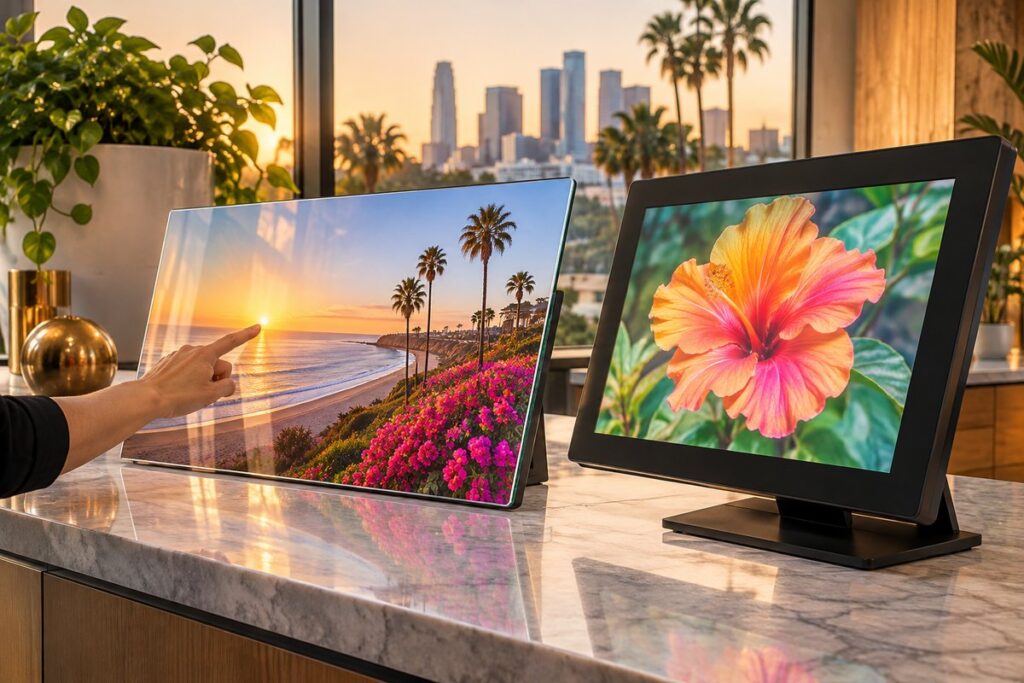
Pre-built touch monitors come as all-in-one units with integrated displays and touch sensors. These are ideal for enclosed kiosks or situations where the touch surface need not be separated from the electronic components, such as directory panels inside lobbies or private meeting spaces. In Los Angeles, common use cases include interactive signage at shopping centers or digital donor walls at cultural institutions.
Advantages of touch monitors include simplicity and minimal setup: just power up, connect your media player, and the unit functions as a familiar giant tablet. However, standard monitors typically max out at stock sizes, with limited options on shape and edge-to-edge glass. They generally aren’t suited for immersive, full-glass facades or customized touch tables—even more so when historic preservation or design statements matter, as in many Hollywood or Venice Beach storefronts.
Choosing monitors restricts flexibility. If you need large, custom-sized panes, seamless integration with existing architecture, or a truly invisible touch overlay, touch foil offers more creativity and scalability. For a closer look at sizing possibilities, review Touch Foil Sizes and Specifications.
Infrared Touch Frames: Strengths and Drawbacks
Infrared (IR) touch frames work by mounting a thin bezel with LED emitters and receivers around a display, creating a grid of invisible light beams. Anything interrupting these beams—such as a finger—registers as a touch. IR frames can be retrofitted onto large displays or glass panels, making them a popular “bolt-on” solution for exhibit designers and AV integrators across LA’s event venues and trade shows.
While IR frames support large formats and work through thick glass, they do require a visible bezel, and may be more prone to interference from dust, sunlight, or reflective surfaces—especially a consideration in brightly-lit Los Angeles spaces or near outdoor street-facing windows. The visible border may also clash with minimalist design goals for luxury real estate lobbies or high-traffic hotel foyers.
Touch foil, in contrast, is completely behind the glass with only a thin controller and cable visible out of sight. This delivers a totally seamless effect that keeps focus on your content and architecture, especially important in tourist-heavy districts aligning with Visit California branding campaigns.
Comparing the ProFoil Range: Standard, Pro Touch, Object Recognition, and Clear
The TouchFoil line-up provides multiple models, each addressing specific application needs. Understanding these differences helps retailers, museums, and corporate designers in Los Angeles match the right foil to their project.
- ProFoil Standard: Offers 10 touch points, operates through glass up to 10 mm thick, with automatic calibration. Suitable for interactive storefront windows and public info points up to 55 inches.
- Pro Touch 20/40: Starts with 10 touch points (under 32 inches), scaling up to 20 or 40 points for larger displays, through glass up to 12 mm. Works with laminated double glass (no air gap), supports Mac on the 40-point version (if macOS and app permit), from 10.1 to 100 inches, with zone calibration. Ideal for classrooms, universities, and collaborative tables.
- Object Recognition: Handles 40+ touch points, recognizes marker pucks (5 per set, expandable) through up to 10 mm glass, for areas 43-75 inches. Offers an SDK for developers and turnkey package for advanced interactive exhibits or retail experiences such as real-estate model tables or art galleries.
- ProFoil Clear: A fully transparent foil with no visible grid, supporting 10 touch points, for up to 98-inch panels and supplied laminated on glass. The best fit for custom architectural installs where aesthetics rule—think hospitality or high-end jewelry storefronts along Rodeo Drive.
For circular glass tables—including gallery interactives or hospitality domes—the Circular Touch Foil addresses round applications up to 140 cm or joined halves up to 280 cm in diameter.
Key Factors for Los Angeles Projects: Size, Glass, Permits and Power
Local conditions matter: Los Angeles’ diverse climates, tough seismic standards, and building energy codes shape what’s practical for interactive through-glass installs. Always check local office requirements for glass type and emergency egress before finalizing a design. Using the recommended configuration—no metal in glass, keeping metal parts at least 3 mm from the foil, proper electrical grounding, and routing USB cables away from power—will help ensure reliable operation in busy retail or educational settings.
Retail and hospitality applications in sunny neighborhoods like Santa Monica benefit from high light transmission foils (TouchFoil achieves 89%+; ProFoil Clear starts at 85%), keeping interiors bright and inviting. Be sure to coordinate with lighting designers for the right display brightness and select rear-projection or LCD hardware to match the local ambient lighting.
Before installing, remember that foils are a one-time permanent application. Always test fit, and consult LA regulations (check with city permitting and code authorities). For tourism-driven districts or spaces aligning with interactive campaigns, partnering with marketing and tourism agencies such as Visit California can help maximize exposure.
Installation and Maintenance: Practical Tips for Busy Spaces
Installing touch foil is straightforward but requires precision: the glass must be clean and free of oils or debris, and the foil’s active area accurately lined up to match your display edges. After wet-applied install, drying takes 24 to 48 hours; plan accordingly to minimize disruption in high-traffic areas or operational hours. Foils cannot be moved—each install is permanent to its pane—so always verify placement before fixing in place.
Touch foil operates on low 5V USB power (from the included controller). For optimal performance and support longevity, permanently attach the controller to the frame and ground it as recommended. This is particularly essential in busy Los Angeles installations where reliability over time matters—such as public information stations or ticketing kiosks at busy tourism sites.
Cleaning is simple: just treat the glass surface as you would any window. Internal wiring is hidden, reducing tampering and keeping the overall profile slim.
Touch Foil Through Glass: Unique Benefits for LA Retail, Museums and More
Few technologies deliver the invisible interactivity of touch foil—making it ideal for blending digital innovation with architectural glass. Large windows, glass walls, or circular tables become immersive displays for passersby or participants, without bulky bezels or exposed electronics. This is especially valuable in design-sensitive environments such as luxury storefronts, hotels, high-end auto dealerships, and interactive museum galleries.
Beyond retail, touch foil tables foster engagement at education centers, while interactive kiosks aid wayfinding in airport concourses or popular meet-up spots. Supporting both rear-projection and LED/LCD setups lets you match your vision to the space—whether that means a sunlit hotel lobby in Santa Monica or a darkened theater lobby along Hollywood Boulevard.
If your project requires massive custom sizes, see the detailed dimensional ranges at Touch Foil Models. For projection-based displays, explore pairing with solutions from RearProjectionFilms.com for optimal image quality behind interactive glass.
FAQ: Choosing and Using Touch Foil in Los Angeles
What thickness and type of glass can touch foil work with?
ProFoil Standard, Object Recognition, and ProFoil Clear all operate through glass up to 10 mm; Pro Touch 20/40 supports glass up to 12 mm, including laminated double glass (without an air gap). Avoid any glass that contains metal, and keep metal framing at least 3 mm from the foil’s edges for accurate touch sensing.
How do I choose the right ProFoil model for my application?
Match your project’s size, touch point requirements, and interactivity needs. For most single-user or info point applications, ProFoil Standard is sufficient. If you want object or puck recognition for multi-user environments, Object Recognition model is recommended.
Is touch foil suitable for use with projectors, or only LCD/LED screens?
Touch foil works with both projector-based rear-projection setups (when paired with the right rear-projection film) and LCD/LED displays. This flexibility allows for large interactive glass walls, touch tables, and storefronts—great for customized Los Angeles installations. For pairing with the ideal display or projection hardware, see guidance at How Touch Foil Works and How to Install It.
Conclusion: Selecting Your Interactive Glass Solution
Deciding between touch foil, touch monitors, and infrared frames comes down to project goals and the unique context of your Los Angeles location. Touch foil offers real flexibility for custom glass sizes, a seamless appearance, and interactivity through glass up to 12 mm thick, with several models to match virtually any use case. For tailored sizing, advanced object recognition, or invisible installs, the TouchFoil products from SSI deliver broad application coverage.
To explore sizing, technical details, or get custom advice for your Los Angeles project, the next step is to Get a quote. Connect your vision to technology—and build interactive spaces that engage and inspire.